

Google’s approach to content quality shifted significantly in 2025, and the same standards are carrying into 2026. With AI-generated content at an all-time high, Google’s systems are now better at separating genuinely useful content from content built to game rankings. EEAT is at the centre of how Google makes that judgement. This guide covers what E-E-A-T is in SEO, why the 2022 change from EAT to EEAT still matters, how it connects to YMYL, and what has changed in 2026 that you need to know.
What Does EEAT Stand For?
EEAT stands for Experience, Expertise, Authoritativeness, and Trustworthiness. It comes from Google’s Search Quality Rater Guidelines — the handbook used by thousands of human reviewers Google employs to evaluate search result quality.
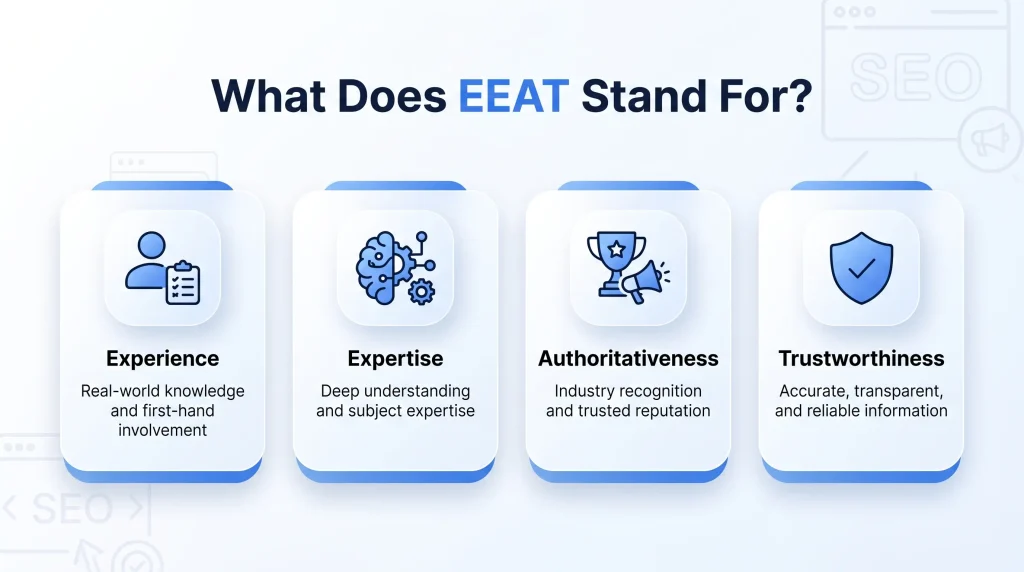
Trustworthiness is the strongest factor among the four. A page that appears experienced and authoritative but publishes inaccurate content is still rated as low EEAT.
Is EEAT a Direct Google Ranking Factor?
No — EEAT is not a direct ranking factor, and there is no EEAT score.
Google’s systems do not assign a number to your page based on EEAT. Instead, Google builds its ranking algorithms to reward the indirect signals that strong EEAT produces — author credibility, content depth, backlink quality, site security, and factual accuracy.
Think of EEAT as the standard your content is measured against, not a single dial you can turn up. You improve it by improving the signals it represents.
What is EAT vs EEAT: The Full History
EEAT did not appear in 2022 without context. Here is the full timeline that explains why Google made each change and where things stand today.
| Year | Event | What It Meant |
|---|---|---|
| 2014 | EAT was introduced in Google’s SQRG | Google formalised Expertise, Authoritativeness, Trustworthiness as content quality criteria |
| 2018 | ‘Medic’ algorithm update | Health and finance sites saw major ranking shifts — EAT became widely understood in SEO |
| Dec 2022 | Experience added — EAT becomes EEAT | Google shifted focus from credentials alone to real-world, first-hand experience with the subject |
| Mar 2024 | Helpful Content System merged into core | Content quality became a permanent part of Google’s main algorithm, not a separate layer |
| Jan 2025 | SQRG updated — YMYL expanded | Government, civic, and election content added to YMYL; AI content abuse guidelines tightened |
| Sep 2025 | SQRG revised again | AI Overview evaluation criteria added; stricter guidance on low-effort scaled AI content |
| Dec 2025 | Core Update | Significant ranking drops for generic AI content farms; original, reviewed content rewarded |
| 2026 | Current standard | EEAT is the baseline expectation — not a differentiator but a requirement to compete |
The key shift from EAT to EEAT: Google moved from asking ‘are you qualified?’ to asking ‘have you actually done this?’ Credentials still matter, but direct experience with the subject now carries equal weight.
Breaking Down Each EEAT Component
Experience
Experience means you have personally encountered the situation you are writing about — not that you researched other people’s opinions on it. A product review from someone who used the product for six months ranks above one written by someone who read the spec sheet.
How to show it:
- Use real numbers from your own work — not ‘traffic improved’ but ‘organic traffic increased 34% in 90 days.’
- Include original screenshots, photos, or data you generated yourself
- Mention what did not work, not just what did — real experience includes failure
- Write in first person where it fits naturally — ‘when I tested this,’ ‘in a client project last year.’
Expertise
Expertise is demonstrated knowledge — the ability to explain a topic correctly, in context, and with depth. It is judged relative to what the subject demands. A medical article about drug interactions requires a qualified author. A beginner’s guide to bread does not require a professional baker.
How to show it:
- Go beyond the definition — explain the ‘why’ and cover the edge cases
- Correct common misconceptions directly in your content
- Use accurate, specific terminology — vague language signals shallow knowledge
- Have high-stakes content reviewed by a verified subject matter expert
Authoritativeness
Authority is external. It is how the rest of the web perceives you — built through references, citations, and mentions by others, not through what you say about yourself on your own site.
| Authority Signal | Why It Matters in 2026 |
|---|---|
| High-quality backlinks from trusted and relevant domains | It still acts as a strong trust signal from others within your industry niche |
| Brand mentions without a backlink | Google’s entity recognition system tracks mentions without requiring direct links |
| Guest posts on established websites | Helps grow your author presence across other domains |
| Regular content built around a specific topic cluster | Helps Google see you as a specialist |
| Awards, citations, and media mentions | Externally verified third-party credibility |
Trustworthiness
Trustworthiness is the most weighted EEAT signal. It applies to both your website and your content.
Website-level trust signals:
- HTTPS on every page
- Clear contact page with a real business address or email
- Transparent About page explaining who runs the site and why
Content-level trust signals:
- Factually accurate, up-to-date information with cited sources
- Named author with credentials visible on the page
- ‘Last updated’ or ‘last reviewed’ date displayed
What Is YMYL — and Why It Changes Your EEAT Standard
Your Money or Your Life is what YMYL stands for. It addresses issues where a person’s health, finances, safety, or general well-being could be seriously harmed by false information. Compared with general content, YMYL pages are subject to much stricter EEAT standards set by Google.
| YMYL Category | Examples | EEAT Requirement |
|---|---|---|
| Health & Safety | Medical symptoms, medications, and mental health | Expert authorship or medical review required |
| Financial Security | Investments, tax guidance, loans, and insurance | Credentials, disclaimers, and sourced data required |
| Legal Information | Rights, contracts, legal processes | Qualified legal author or reviewer expected |
| Government & Civics | Elections, voting, public institutions | Strict accuracy; scope expanded September 2025 |
| Safety & Emergency | Emergency procedures, dangerous activities | Highest trust standards — no room for error |
If your blog is not in a YMYL niche, EEAT standards still apply — but there is more room for experience-led content over formal qualifications. If you are in a YMYL niche, formal credentials, cited sources, and named expert authors are effectively required to compete.
EEAT and AI Content in 2026: What Google Penalises
Google does not penalise AI content by default. It penalises low-effort content — and AI makes low-effort content easy to produce at scale. The December 2025 Core Update demonstrated this clearly with widespread declines across generic AI content sites.
What Google penalises:
- Content that is generic and restates already-existing pages without adding anything new
- Articles without a named author and no responsibility for accuracy
- Scaled content released in large quantities without expert or human review
- AI-generated reviews or how-to manuals that lack proof of authorship
‘Who, How, Why’ self-check on Google:
| Question | What a Strong EEAT Answer Looks Like |
|---|---|
| Who created this? | A named person with a verifiable professional profile — not ‘Editorial Team’ or anonymous |
| How was it created? | Human expertise and research matter — AI is useful only with expert refinement |
| Why was it created? | To actually respond to a user’s query rather than to fill in a keyword gap or increase the number of pages |
In 2026, AI will be able to surface basic information and draft structure. A human who truly understands the subject must provide the precise examples, corrections, original data, and author accountability.
How to Improve Your EEAT in 2026
1. Create a named, credentialed author profile
Include your full name, job title, years of experience, a picture, and a link to your LinkedIn profile or portfolio in your author bio. Regardless of how well-written it is, anonymous content sends a weak trust signal. A verified human author is a significant differentiator from AI-generated content in 2026.
2. Display ‘last reviewed’ dates on every post
A trust issue is outdated content. Include and keep a “last reviewed” date. Review SEO-related topics every six months. Every year for evergreen content. More often for YMYL content.
3. Cite sources rather than blog entries.
Link to official government data, published research, Google documentation, or reputable industry reports. Citing blog entries that cite other blog entries results in a chain that ends without a verified source. Links to primary sources indicate that the information in your content is reliable.
4. Build a content cluster around your topic
A single optimised post is insufficient. Google assesses your authority in a topic cluster. A blog that covers E-E-A-T from several perspectives, such as audit frameworks, niche-specific guides, improvement strategies, and definitions, indicates a deeper level of expertise than a single page.
5. Fix your internal linking
Every supporting post should link back to your pillar content. Internal linking distributes authority, improves crawlability, and signals that your content ecosystem is organised and intentional.
6. Build authority externally
The important authority signals include being cited in research, having a guest post on a relevant publication, and having your brand mentioned in industry content. Google’s entity recognition technology is advanced enough in 2026 to distinguish real authority from fake link profiles.
EEAT Checklist for 2026
| Before You Publish | |
| 1 | Author name, bio, and credentials visible on the page |
| 2 | Last reviewed’ or ‘last updated’ date displayed |
| 3 | At least one primary external source cited and linked |
| 4 | Content matches the exact search intent |
| 5 | Internal links to relevant posts and pillar content included |
| 6 | HTTPS active — contact and About pages complete |
| 7 | All claims are specific — no vague statistics or unattributed data |
| 8 | Content reviewed for factual accuracy by a human |
| 9 | No keyword stuffing, padded sections, or filler |
| 10 | Author credentials externally verifiable |
| 11 | If AI were used, a subject matter expert has reviewed the output |
| 12 | Content adds something not already covered by competing pages |
Frequently Asked Questions
What does EEAT stand for in SEO?
Experience, expertise, authoritativeness, and trustworthiness are all represented by the acronym EEAT. It is Google’s method for determining whether content is reliable and written by someone who actually understands the subject.
Is EEAT a direct Google ranking factor?
No, the EEAT score does not exist. Although EEAT is not a direct, quantifiable input, Google’s ranking systems are designed to reward the signals that strong EEAT generates, such as author credibility, content accuracy, and backlink quality.
What changed between EAT and EEAT?
In December 2022, Google added Experience to the original EAT framework. This elevated the importance of firsthand involvement with a topic over credentials. Someone who has done the thing ranks above someone who only studied it.
What is YMYL and how does it affect EEAT?
YMYL (Your Money or Your Life) covers topics where bad information causes real harm — health, finance, legal, safety, and civic content. Google applies its strictest EEAT standards to these areas. Competing in YMYL without expert authorship and cited sources is very difficult.
Can AI content affect EEAT rankings in 2026?
Not automatically. AI content reviewed by a subject matter expert, attributed to a named author, and enriched with original insight can rank well. AI content published without those safeguards — generic, unreviewed, no real author — is what gets penalised.
How do SEO companies in Delhi build website authority and trust?
Positive user experiences, authentic backlinks, high-quality content, and strong brand credibility are all ways that businesses can increase the authority and trust of their websites. To improve rankings and foster long-term trust, many SEO companies in Delhi also adhere to Google’s EEAT guidelines.
How long does it take to improve EEAT to show results?
Foundational changes such as author bios and updated dates can show impact within 4 to 8 weeks. Authority-building — backlinks, brand mentions, topical depth — typically takes 3 to 6 months, with some signals taking up to 12 months.
Conclusion
E-E-A-T is not a checklist to check off and forget about. 2026, Google expects more from websites: AI-generated material everywhere. Today, the basic requirements to compete are a real author, real experience, real information, and a real website. It’s not always the content with the most keywords that ranks, but the content that makes readers feel like they can really trust it.
If your content lacks clear authorship, first-hand experience, reliable information, or website credibility, work on building those things before you make any more keyword or meta description changes. And for MyFirstAd, it’s about delivering useful, authentic content that shows real expertise and earns trust from users and Google to do that. Trust is the difference between good content and content that actually works in today’s SEO world.

