

You’ve spent months building your brand. Great products. Good team. Decent ad spend. And then — one bad review on Google, a rant thread on Twitter, or a negative news article — and suddenly your phone goes quiet.
This happens more than you’d think.
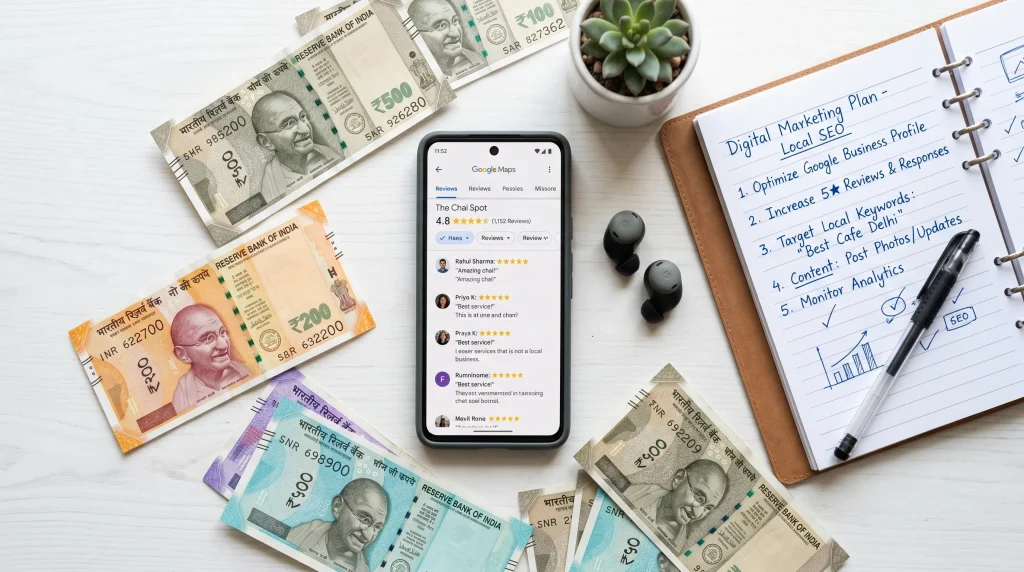
In India, where over 900 million internet users are projected by 2026, and where people check Google before trusting any business, your online reputation is as important as your product itself. One bad search result can quietly cost you dozens of potential customers every single day. That’s exactly where ORM in digital marketing steps in.
In this guide, you’ll learn what ORM actually means (not just the textbook definition), how it connects to SEO and social media, what businesses get wrong about it, and how to start building a reputation strategy that works for your brand — whether you’re a startup or an established company.

What does ORM stand for?
ORM is Online Reputation Management. It’s about monitoring, shaping, and improving how your brand appears online – in Google search results, reviews, social media, and news – so that the first impression people have of you is the one that you want.
You break down the phrase, and it makes sense. It all happens online – Google, Justdial, Zomato, Instagram, news sites, and forums. Reputation is what people think of you, based on reviews, ratings, comments, press coverage, and how you deal with problems when they happen. It does not mean controlling or deleting what anyone says. You can’t erase honest criticism. What you can do is respond well, fix the problem behind the complaint, and build up enough positive content that the overall picture of your brand is fair.
Why Does ORM Matter So Much for Indian Businesses Right Now?
Consider this: 79% of consumers place the same level of faith in internet reviews as they do in personal recommendations (BrightLocal, 2024). This is a huge change in India, where word of mouth has always been a powerful driver of purchasing; it’s just moved online.
More numbers to explain the urgency:
-
- The global ORM market was worth around USD 4,523 million in the year 2024 and is expected to grow at a CAGR of more than 16% to reach USD 17,456 million by 2032.
-
- The ORM market in the Asia Pacific is growing specifically at 14% CAGR through 2033, heavily driven by India’s digital expansion
-
- 87% of 18–24-year-olds say online reviews influence their purchase decisions — a demographic that forms the backbone of India’s growing digital consumer base.
Indian businesses — from e-commerce brands to local service providers to D2C startups — are beginning to realise that your Google Knowledge Panel, your Justdial reviews, and your social media comments section are now your first impression. Not your shopfront, not your ad. Your search result.
What Are the Core Components of ORM in Digital Marketing?
ORM is not a thing. “It’s a mix of strategies that come together. This is how a full ORM approach falls apart:
1. Review of monitoring and management
This is the most obvious bit. That means monitoring closely what people are saying about your brand on Google, Facebook, Amazon, Zomato, MakeMyTrip, Justdial, and all those industry-specific review sites.
The goal isn’t just to read the reviews — it’s to respond to them. Promptly. Professionally. Even the bad ones. Compared to a brand with just 5-star ratings and no interaction, a brand with a 2-star review and thoughtful response will frequently garner greater trust. Consumers are able to distinguish between a managed and authentic reputation.
2. Search Engine Results Page (SERP) Management
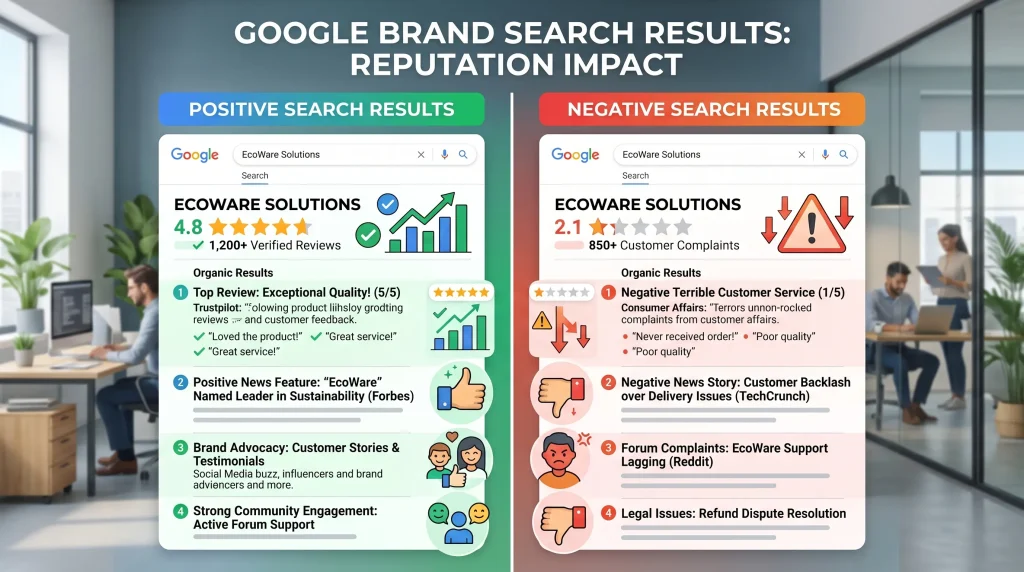
When someone goes to Google your brand, the top 10 results are your reputation. ORM works to ensure those results are accurate, positive, and controlled by content you’ve created or influenced — your website, blog, press releases, social profiles, and third-party features.
This is where SEO and ORM overlap significantly. More on that shortly.
3. Social Media Monitoring
Conversations about your brand happen on Instagram, Twitter/X, LinkedIn, YouTube comments, Reddit, and WhatsApp groups (though the last one is harder to track). ORM includes actively monitoring brand mentions, hashtags, and tagged content across these channels.
Tools like Google Alerts, Mention.com, Brand24, and Sprinklr help automate a lot of this.
4. Content Creation and Publishing
A good ORM strategy creates a library of content that shapes your brand story proactively. This involves:
-
- Blog posts that answer customer questions
-
- Customer success stories and case studies
-
- Video Testimonial
-
- Press Release & Media Features
-
- LinkedIn leadership articles
You have more control over what people see when they look you up, the more high-quality content you have attached to your brand.
5. Crisis Management
This is the reactive side of ORM – having a plan in place before a PR crisis strikes. It could be a negative review that goes viral, a product recall, or a social media controversy. Often, how your brand reacts in the first 24-48 hours will determine if the situation escalates or de-escalates.
Credit: Flow AI
How Does ORM Work with SEO?
SEO and ORM are more connected than most people realise. In fact, you can’t do proper ORM without understanding SEO — and you can’t build sustainable SEO without managing your reputation.
And here is where the overlap is:
-
- Branded search results: If someone searches your business name, Google pulls the highest authority pages about you. If your own website and social profiles are well-optimised, they dominate those results. If they’re not, third-party content — including negative coverage — can rank higher than your homepage.
-
- Review Signals: Google considers the quantity, quality, and recency of reviews as a local SEO ranking factor. More positive reviews = more exposure to the local pack. ORM feeds the generation of reviews and, in turn, SEO.
-
- Content suppression. One of the most popular tactics in ORM is to create quality content that will rank higher than negative pages. It’s not so much about hiding issues as it is about making sure the most accurate and current portrayal of your brand is the first thing people see.
-
- E-E-A-T: Google’s quality framework (Experience, Expertise, Authoritativeness, Trustworthiness) is essentially a reputation assessment. Your Wikipedia presence, media mentions, author bios, and backlink profile all contribute to this — and they’re all ORM levers.
For Indian businesses working with a performance marketing agency, integrating ORM into the overall digital strategy — rather than treating it as a separate silo — is what sets brands that grow consistently apart from those that plateau.
What Is ORM in Social Media, and Why Does It Need Separate Attention?
Social media ORM is its own discipline within online reputation management. Here’s why it deserves separate attention:
Social platforms move faster than Google. A tweet or Instagram story can go viral in hours. The feedback loop is immediate and public. Comments happen in real time. Unlike a Google review, social media content is often shared, screenshotted, and spread far beyond the original platform.
What does ‘social media ORM’ mean?
-
- Track what people say about your brand, even if they don’t tag you directly
-
- Responding to DMs and comments within a defined SLA (most brands aim for under 2 hours)
-
- Identifying and combating misinformation before it spreads
-
- Activating positive mentions to boost them
-
- Having escalation protocols for bad viral situations
And then there is the influencer angle. Reputational weight comes from user-generated content, micro-influencer campaigns, and brand collaborations. ORM is being mindful of the people you choose to do business with and how those associations affect your brand.
The benefits of social media marketing are greater when your reputation is spotless. Because there is already brand credibility, audiences are more open to your content, influencers are more eager to collaborate with you, and your paid campaigns are more successful.

Credit: Flow Ai
What’s the Difference Between SEO, Digital PR and ORM?
SEO helps people find you, digital PR gets people talking about you, and ORM ensures that what they find and hear is accurate and positive. They overlap and work best together, but each one solves a different problem for your brand.
It’s easy to blur them because all three live on Google and all three care about trust. The difference is what each one does.
Here’s an example. For example, a Delhi clinic ranks high for “best dermatologist in Saket” because of its SEO. That’s digital PR, and a local news story gives credibility. But if the first thing that a person sees when they search the clinic’s name is a one-star review and there is no response to it, that is the ORM problem. Without it, the traffic SEO brings in may not convert into appointments.
ORM is specifically digital-first. It’s measurable, ongoing, and deeply tied to both SEO and customer experience. PR and brand management inform ORM strategy, but they’re not substitutes for it.
In short, a good ORM strategy takes elements from both. SEO ranks your good content, and digital PR gives you good third-party mentions to rank with. ORM sees the whole picture.
What Are the Most Common ORM Mistakes Businesses Make?
Knowing what not to do is sometimes more useful than knowing what to do. These are the ORM mistakes we see most often:
1. Turning a blind eye to bad reviews. Silence is assumed to be indifference. When customers read reviews, they see complaints that go unanswered, and they think the brand doesn’t care. Whatever you do, reply; even if it’s just to acknowledge the issue and invite the customer to connect offline.
2. Only doing ORM when there’s a crisis. By the time you need ORM urgently, building a positive reputation from scratch is already too late. ORM is a prevention and maintenance strategy, not just a fire extinguisher.
3. Trying to bluff it. Paid-for ratings, astroturfing, bogus reviews. In August 2024, the FTC began action against phony and artificial intelligence-generated reviews. Google’s computers are getting better at spotting fraudulent activity. The long-term risk outweighs the short-term reward.
4. Not monitoring. You consistently can’t manage what you don’t measure. Many businesses check their reviews once a month. By then, a negative narrative could already be shaping perceptions for weeks.
5. Thinking ORM is only a marketing team’s job. Reputation is about customer service, product quality, HR practices, behavior of founders. ORM needs to be a company-wide mindset, and not just a department’s KPI.

Credit: Flow AI
What is the Cost of Reputation Management?
ORM in India often costs ₹10,000 – ₹25,000 a month for simple monitoring and review management and ₹50,000 to several lakhs a month for full-scale methods. You pay for your scope and how much work your reputation needs to be repaired.
The pricing depends on:
- Brand Position: It’s considerably cheaper to manage a new brand than to recover from a viral complaint or a detrimental news item.
- No. of Platforms: It is cheaper to monitor Google reviews alone than to monitor Google, social media, marketplaces, and news.
- Industry and competition: More attention and effort are given to sensitive industries such as healthcare, finance, and education.
- Online presence size: More locations, more goods, and greater review volume mean more to watch and reply to.
|
LEVEL |
APPROX MONTHLY COST |
WHAT’S INCLUDED? |
|
Basic |
₹10,000 – ₹25,000 |
1. Review monitoring and response, Google Business Profile maintenance, and alerts on brand mentions. |
|
Standard |
₹25,000 – ₹50,000 |
2. Basic + more platforms, track search results, some regular content |
|
Comprehensive |
₹50,000 – several lakhs |
3. Content Creation, Social Media Monitoring, Crisis Communication and Media Outreach |
Most agencies charge a monthly retainer, as reputation work is a continuing process. Some provide project-based pricing for a specific cleaning or disaster. If you merely correct things once and then quit, the problem tends to come back.
What are the Tools Used for ORM in Digital Marketing?
Here’s a quick rundown of the tools that are actually used by professional ORM practitioners:
-
- Google Alerts – Free, basic, still good for monitoring your brand mentions
-
- Mention / Brand24 — Real-time social and web monitoring with sentiment analysis
-
- ReviewTrackers / Birdeye – Review aggregation and response management across channels
-
- SEMrush / Ahrefs – backlink analysis, competitor research, SERP tracker
-
- Sprinklr / Hootsuite – Enterprise social media listening and response management
-
- Yext – Local directory listing management, important for local ORM
Google Alerts + a review management platform + consistent content publishing covers the basics well for most Indian SMEs starting.
How to Develop an ORM Strategy from Scratch
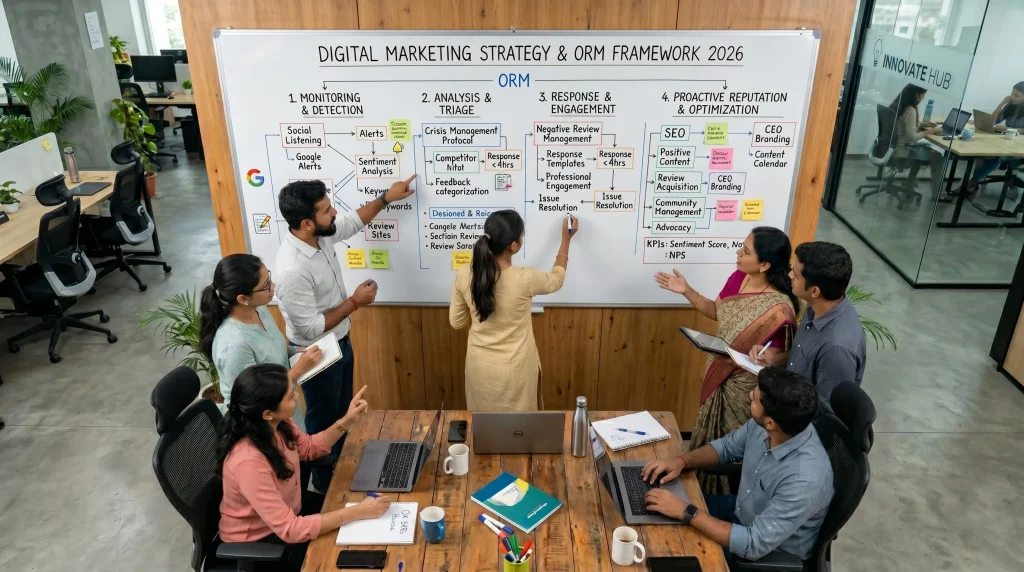
Here’s a practical, step-by-step approach to building an ORM strategy that actually works:
Step 1: Audit your current reputation. Search your brand name in incognito mode. What comes up on page 1? Check Google reviews, Justdial, Facebook, and LinkedIn. Note everything — positive and negative.
Step 2: Claim and optimise all brand profiles: Google Business Profile, LinkedIn company page, Facebook, Instagram, Twitter/X, YouTube, and all relevant industry directories. Full profiles rank higher and appear more trustworthy.
Step 3: Implement a review generation system. Ask happy customers for reviews — via email, WhatsApp, or post-service follow-up. Make it easy. Most people who had a great experience won’t think to leave a review unless prompted.
Step 4: Make a content calendar based on authority. Post case studies, blog posts, and professional opinions to establish your brand as an informed, reliable source in your industry. This is a long-term strategy that pays off in terms of reputation and SEO.
Step 5: Create protocols for reaction and monitoring. Decide who will respond to reviews, how quickly, and in what manner. Always make adjustments, but create templates for typical situations.
Step 6: Measure and repeat in step six. Every month, look at your sentiment trends, branded search impressions, average rating, and review volume. Utilize the information to improve your approach.
Partnering with a performance marketing agency in India with a holistic understanding of ORM can speed up all six steps significantly, especially for brands that do not have in-house expertise yet.
Credit: Flow AI
What Influences the ORM of Different Types of Businesses?
ORM strategy is not a one-size-fits-all. And here’s how priorities change by business type:
-
- E-commerce brands: your reviews on Google Shopping, Amazon, and Flipkart matter a lot. How quickly you respond to returns and handle delivery issues can greatly impact your reputation.
-
- Service businesses: Google Business Profile reviews and LinkedIn presence are most important (agencies, consultants, clinics, etc.) Testimonials and case studies on the website also count a lot.
-
- Social media ORM is key for D2C brands. Instagram comments, influencer reviews, and YouTube unboxing videos influence brand perception in real-time.
-
- Local businesses (restaurants, salons, retail): Google and Zomato/Swiggy/Justdial reviews are everything. Local SEO and ORM overlap almost completely here.
-
- Startups raising funding: Founder reputation, media coverage, and LinkedIn authority matter beyond just customer reviews. Investors Google everyone.
Myths vs Facts About ORM
-
- Myth: ORM is only for brands with a reputation issue. Fact: ORM works best when it is started proactively, before the problems occur.
-
- Myth: You can remove negative reviews. Fact: Unless a review violates platform regulations (false, abusive, or spam), the only action you can take is to delete it.
-
- Myth: Reputation issues may be resolved with paid advertisements. Fact: While advertisements increase traffic, they have little effect on what people find when they search for your brand. ORM addresses the search results themselves.
-
- Myth: ORM & SEO are different strategies. Fact: They are very much inter-tangled.
-
- Myth: Small businesses don’t need ORM. Fact: Local customers check Google reviews before visiting any business, however small. ORM is arguably more critical for SMEs, where one bad review represents a bigger percentage of total mentions.
Frequently Asked Questions About ORM in Digital Marketing
What does ORM stand for in digital marketing?
ORM stands for Online Reputation Management. It’s the process of keeping an eye on and influencing how a company, brand, or person is viewed online, including on search engines, social media, review sites, and news websites.
What is ORM, and how does it differ from SEO?
SEO is about ranking higher for particular keywords. ORM is all about what shows up when someone searches for your brand name, and how to improve the overall perception of your brand online. The two strategies are similar but have different primary goals.
How long does it take for ORM to show up?
Depending on how your reputation is now and how hard the strategy is. If you’re just starting to manage reviews and publish content, you might see some improvements in 3-6 months. 6-12 months is a more realistic timeframe for burying entrenched negative results in SERP.
Does ORM remove negative content from Google?
In most cases, no, you cannot force the removal of accurate, non-defamatory content from Google. What ORM does is push positive, authoritative content higher in rankings so that negative content is displaced to lower positions where fewer people see it.
Is ORM relevant for individuals or only for businesses?
Both. Professionals, entrepreneurs, job seekers, and public figures increasingly use ORM to manage their personal brand online — especially on LinkedIn and Google image results.
What is the price of ORM in India?
Cost is very variable. The basic ORM packages from agencies in India start at about ₹10,000-₹25,000 per month. More comprehensive strategies that can include active content creation, social monitoring, and crisis management can cost anything between ₹50,000 and several lakhs per month, depending on the scope.
What is the relationship between ORM and performance marketing?
A strong ORM foundation improves performance marketing ROI. When your reputation is positive, ad click-through rates are higher, landing page conversion rates improve, and your cost per acquisition decreases — because prospects already trust your brand before they click your ad.
Final Thoughts
Your brand’s online reputation isn’t just what you say about yourself — it’s the total of what your customers, critics, competitors, and the internet say about you. And in 2026, that conversation is always happening, whether you’re participating or not.
The businesses that win are the ones that show up — in search results, in review responses, in social conversations — with consistency, authenticity, and a clear voice. ORM isn’t a one-time fix. It’s an ongoing discipline, like maintaining your product quality or your customer service standards.
If you haven’t thought seriously about your online reputation strategy yet, now is a genuinely good time to start. The longer you wait, the harder it gets.
At MyFirstAd, we help businesses across India build digital marketing strategies that don’t just generate clicks — they build lasting brand trust.
