Search has quietly changed shape. Plenty of people now type a question into Google, Perplexity, or ChatGPT and read a single written answer, never clicking through to a website. If your pages aren’t feeding that answer, you’re missing from a conversation your customers are already having. That’s what AI search optimization is about.
The encouraging part is that you’re not starting over. AI SEO leans on the same foundations good SEO always has: pages that can be crawled, content people trust, and a site that makes sense. The bar is just higher now. Here are six steps to work through, followed by the mistakes that eat the most time.
How Do I Check Whether Search Engines Can Access My Website?
Open Google Search Console and look at what’s actually indexed. Then test your most important pages one by one. AI search engines find website content. The way regular search does it: they crawl a page, index it, and pull out the passages that fit a question. If a page can’t be fetched or read, it can’t be cited, so sort this out before you rewrite a single sentence.
Verify indexing and crawlability in Google Search Console.
In the Pages report, pay attention to “Crawled – currently not indexed” and “Discovered – currently not indexed”. Both mean Google saw the page and decided not to keep it. Run URL Inspection on your key pages to see what Google sees.
Check robots.txt, canonical tags, and JavaScript-rendered content.
It’s surprising how often a single stray disallow line blocks a whole folder or a wrong canonical point from Google away from your best page. And if your main content only loads after JavaScript runs, some crawlers will never see it. Compare “view source” with the rendered page, and you’ll know quickly.
Identify pages that are indexed but provide little useful information.
Old announcements, empty tag pages, and near-blank location pages don’t help anyone. Improve them, merge them, or remove them.
| Check | Tool | What to look for |
| Indexing status | Search Console (Pages report) | Key pages excluded |
| Live fetch | URL Inspection | The page can’t be fetched or rendered. |
| Crawl rules | robots.txt tester | Accidental blocks |
| Canonicals | Screaming Frog, Sitebulb | Wrong or redirected canonicals |
| JS rendering | View source vs. inspect element. | Main content missing from raw HTML |
| Thin pages | Crawl export + Analytics | Low word count, no traffic |
How Do I Find the Questions My Audience Asks AI?
Start by listening. Support emails, sales calls, reviews, and Google’s “People also ask” boxes are full of the exact words your customers use. People talk to AI tools the way they’d talk to a knowledgeable friend, so their questions run longer and sound more natural than old keywords. Write them down as full questions, then see which ones your site already answers and which it doesn’t.
Turn customer problems into conversational search queries.
Keep their phrasing, even when it’s a bit messy. It’s usually close to what they’ll type into a prompt.
Map questions to existing pages and content gaps.
Put each question next to the page that answers it. A weak match or no match at all is on your to-do list.
Prioritise questions based on audience relevance and business context.
You can’t answer everything. Go after the questions that come from people close to a decision and the ones where you genuinely know more than what’s already out there.
A worked example: Say you run a home loan advisory site, and your broad keyword is “home loan”. That one phrase opens up questions like:
- “How much home loan can I get on a ₹15 lakh salary?”
- “Is a fixed or floating interest rate better right now?”
- “What documents do I need if I’m self-employed?”
- “Can I switch my home loan to another bank, and what does it cost?”
A vague keyword became four real questions, each with a clear reader and a clear page to write.
How Do I Write Pages That AI Search Can Answer From?
Answer first. AI tools lift passages rather than whole pages, and a page that spends three paragraphs clearing its throat makes that job harder, for machines and people alike. State the answer in a sentence or two, then back it up with examples, evidence, and sources. This is really the heart of how to optimise website content for Google AI Overviews and similar tools.
Put the direct answer before supporting details where appropriate.
This works best on pages built around a single question. Don’t force it onto everything.
Use examples, comparison tables, and original evidence.
Anyone can write a generic explanation. Your own numbers, screenshots, and client results are something nobody else can publish, and they give a model a reason to quote you.
Cite reliable sources and keep factual claims current.
Link to primary sources where you can, and check your dates. An out-of-date claim stated with confidence does more harm than saying nothing.
Add relevant author expertise and first-hand experience.
Say who wrote the page and why they know the subject. A short bio and a line about hands-on experience go a long way.
Before: “Switching your mortgage can be a complex decision with many factors. Every borrower’s situation is different, so in this article we’ll explore the topic in depth…”
After: “Switching your mortgage makes sense when the new rate saves you more than the exit and processing fees combined. A gap of 0.5% or more on a large balance usually clears that bar. Of the 40 switches we reviewed last year, 28 broke even within 18 months.”
See the difference? The second version answers straight away, gives a rule you can use, and adds proof only this business has.
How Can I Strengthen My Website’s Topical Coverage?
Before you publish anything new, look hard at what you already have. A site that covers a subject deeply and coherently reads as more trustworthy than one with scattered posts. Link related pages together, give each question one strong home, and refresh whatever has gone stale. Ten sharp pages usually beat thirty tired ones.
Connect related pages using contextual internal links.
Link from the sentence where the idea comes up, and use anchor text that says something. “Our guide to switching home loans” tells the reader and the crawler far more than “click here.”
Build useful topic clusters without creating repetitive articles.
Pick one main guide per topic and let supporting pages each handle a different question. If two pages could be summed up in the same sentence, they’re really one page.
Update outdated facts and consolidate overlapping pages.
If your library is already big, here’s a practical way to tidy it:
- Export every URL with its traffic and last-updated date.
- Group pages by topic and spot the overlaps.
- Choose the strongest page in each group to keep.
- Fold the best bits from weaker pages into it, then 301 redirect them.
- Refresh statistics, screenshots, and dates.
- Link every related page back to the keeper.
How Do I Build Credibility for AI Search Across the Web?
AI tools don’t only read your site. They also pick up on what the rest of the web says about you. Keep your business details the same everywhere, earn real reviews and independent mentions, and only mark up what visitors can actually see. You can’t fake credibility for long. You earn it by being worth citing.
Keep business and product information consistent.
Your name, address, pricing, and service descriptions should match across your website, Google Business Profile, social pages, and directories. Small mismatches make systems and people hesitate.
Use credible reviews, independent coverage, and expert references.
Real reputation looks like a journalist quoting your research or a customer recommending you in a forum thread. Manufactured reputation looks like paid link networks, fake reviews, and guest posts churned out in bulk. The first builds up over time. The second tends to get discounted, and it can hurt you once it’s spotted. If you wouldn’t feel comfortable explaining where a mention came from, leave it.
Use structured data when it accurately describes visible content.
Organisation, article, FAQ, and product markup help machines understand a page. Just make sure it matches what readers can see on screen.
How Can I Measure My AI Search Visibility?
Keep it simple and repeatable. There’s no single dashboard for AI search visibility tracking yet, so make your own. Pick 20 to 30 questions, run them every month on Google AI Overviews, Perplexity, ChatGPT, and Copilot, and write down what comes back. What matters is the trend across months, not any single result.
- Do a continuous series of relevant questions on AI search platforms: Use the same terms always so that the findings will be comparable.
- Citations, mentions, competitors, and answers: Note if you were mentioned, if your link showed up, and who else showed up.
- Keep an eye on the referral traffic and the statistics in the Search Console: see analytics for AI platform visitors. Monitor Impressions for queries of type question.
- Compare findings over time: answers are different each run, each location, and each login status. Give it a few months before you make up your mind.
| Date | Platform | Query | Mentioned? | URL cited? | Competitors | Notes |
| 01 Nov | Perplexity | Can I switch my home loan? | Yes | Yes | Bank A, Site B | Guide cited |
| 01 Nov | Google AI Overviews | Fixed vs floating rate | No | No | Site C | Content gap |
| 01 Nov | ChatGPT | Documents for self-employed loan | Yes | No | None | No link |
Add a summary tab with your mention rate, citation rate, and referral sessions, and you’ve got a reliable picture.
What Are the Most Common AI Search Optimisation Mistakes?
Most of them come from chasing shortcuts. Mass-produced content, tricks that promise guaranteed results, and overreacting to one lucky answer all waste time. Each one has a better alternative, and none of them can stand in for useful, trustworthy pages.
Publishing generic AI-generated articles at scale
These pages repeat what everyone else already says, so a model has no reason to pick yours. Use AI to speed up drafting, then add your own data and an expert’s judgement.
Adding schema or AI-specific files, expecting guaranteed visibility
Markup and files like llms.txt can be useful signals, but no platform has promised citations in return. Treat them as housekeeping, not a strategy.
Creating multiple pages targeting nearly identical questions
Doing this splits your authority across pages that compete with each other. Combine them into one strong page and cover the variations inside it.
Treating a single AI-generated answer as proof of consistent visibility
Answers change from one run to the next. One appearance, or one miss, tells you very little. Track a fixed set of queries over time and judge the pattern.
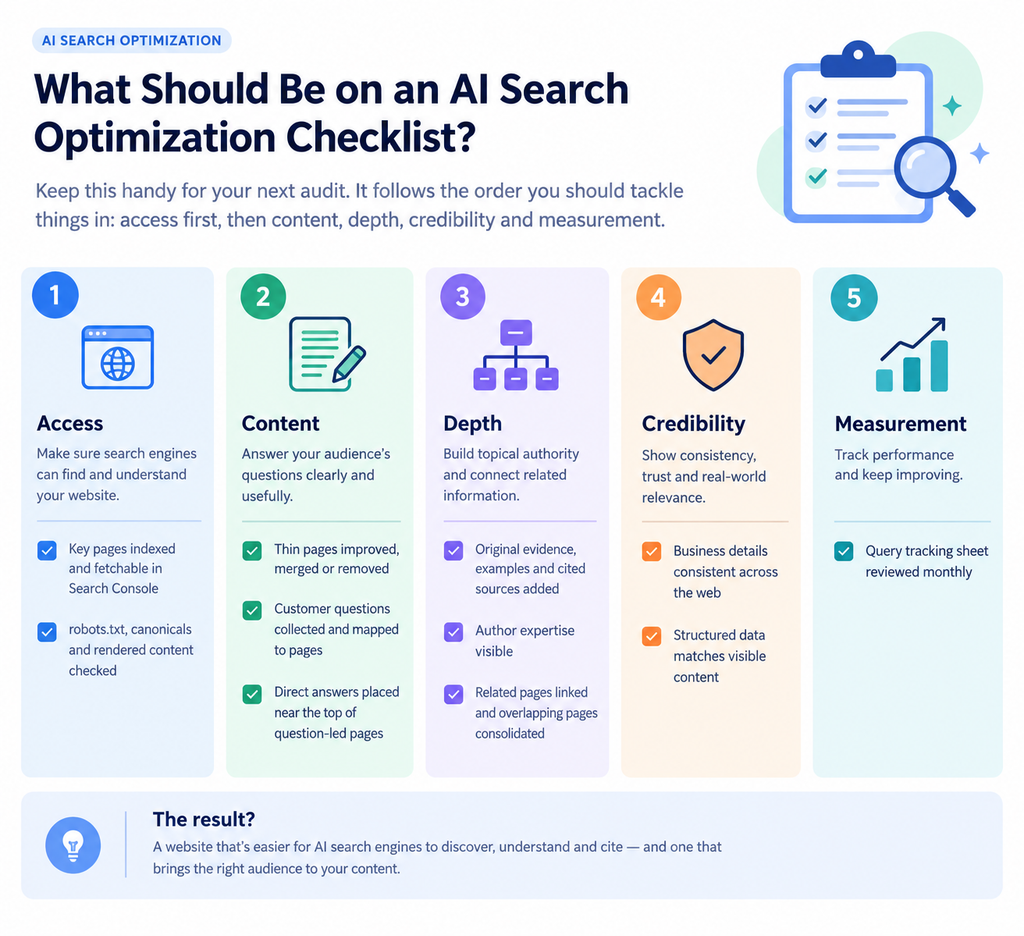
What Should Be on an AI Search Optimisation Checklist?
Keep this handy for your next audit. It follows the order in which you should tackle things: access first, then content, depth, credibility, and measurement.
FAQs (Frequently Asked Questions)
Does traditional SEO still help with AI search?
It does, and more than most people expect. AI tools lean on pages they can crawl, understand, and trust, which is exactly what good SEO has always been about. So don’t throw out what’s working. Treat it as your foundation, then layer on clearer answers and a stronger reputation.
How long does it take to see results from AI search optimisation?
Honestly, it varies, and anyone who gives you an exact number is guessing. Technical fixes can show up within a few weeks, while content and reputation usually take a few months before a pattern appears. That’s why tracking the same queries every month is worth the effort. One quick check won’t tell you much.
Do I need schema markup or an llms.txt file?
No, neither is a must-have, and neither guarantees you’ll be cited. Schema can help machines make sense of a page, as long as it matches what visitors actually see. Think of both as small extras that sit atop useful content and a site that’s easy to crawl.
Can I use AI to write my website content?
Sure, for drafting, outlining, or tidying up a rough version. Where it goes wrong is publishing raw AI output in bulk, because it tends to repeat what’s already everywhere and gives a model no reason to pick you. Add your own data, real examples, and a human expert’s review before anything goes live.
How can I tell whether AI search is sending traffic to my site?
Start with your analytics and look for referral visits from platforms like Perplexity and ChatGPT. Then check Search Console for shifts in impressions on question-style queries. Put that next to your monthly tracking sheet, and you’ll see whether you’re being mentioned or cited, which gives you a much fairer picture than any single number.
Conclusion
Generative engine optimisation isn’t about outsmarting a new algorithm. It’s about being the clearest, most trustworthy answer to a real question and making sure machines can find you. Fix access, learn what your audience asks, answer it well, build depth, earn trust, and measure honestly. Do that steadily and your AI search visibility will follow.
If you’d rather have a team handle the audit and the hands-on work, head over to MyFirstAd and let’s talk about what fits your business.